
Straight Crossdressers and the Guilt of Wanting More
By Jenn der Bentson
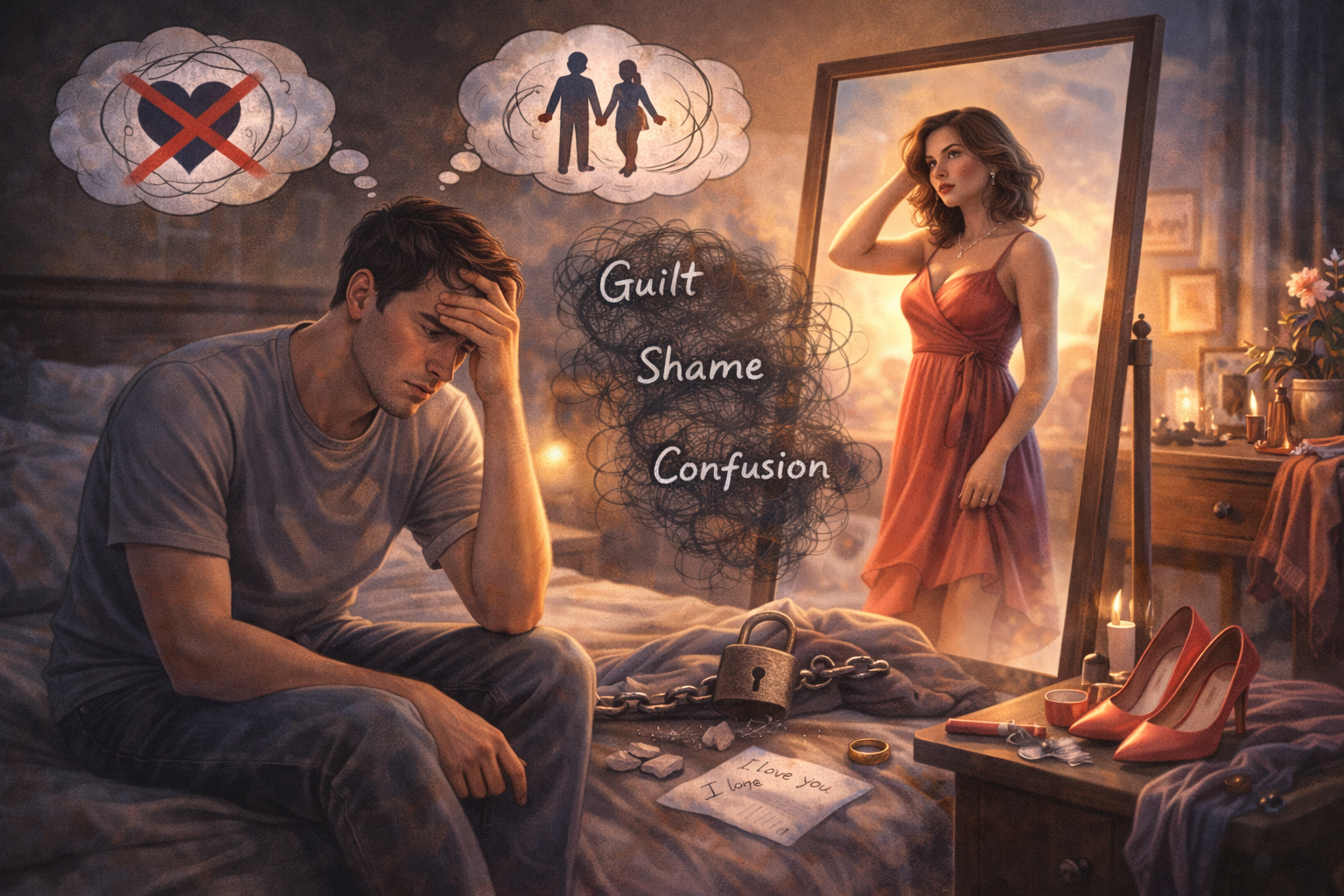 Cross-dressing is often perceived as a private, fleeting act, something done quietly behind closed doors or tucked away in the back of a closet. For many heterosexual men who cross-dress, the experience is intensely personal, tied to self-expression, comfort, and even self-discovery. But for those same men, the act often carries an invisible weight: guilt. This guilt can take many forms, but one of the most persistent and painful is the feeling of wanting more—more time to explore their feminine side, more freedom to dress openly, more visibility in the world—while simultaneously fearing that such desires make them selfish, unfaithful, or demanding.
The paradox of wanting more is at the heart of a struggle that is rarely discussed. Many straight crossdressers internalize the belief that their desires must be hidden, restrained, or minimized to preserve relationships, family harmony, and social acceptance. They may convince themselves that any pursuit of personal expression beyond the private sphere is indulgent, excessive, or morally questionable. Yet this suppression comes at a psychological cost. The yearning to expand one’s cross-dressing experiences—whether through longer dressing sessions, public outings, or even social acknowledgment—doesn’t simply vanish. Instead, it manifests as shame, self-recrimination, and a gnawing sense of incompleteness.
Understanding the Roots of Guilt
The guilt associated with wanting more as a crossdresser is rarely innate; it is cultivated. Cultural, social, and familial pressures create a framework in which heterosexual crossdressers often feel that their interests are abnormal, taboo, or incompatible with their identity as men. From an early age, boys are taught to adhere to strict gender norms—boys don’t wear dresses, boys don’t wear makeup, boys don’t enjoy clothing and styling traditionally labeled feminine. These lessons can leave deep psychological imprints.
For straight men who discover cross-dressing later in life, these pressures often collide with an established sense of masculinity and sexual identity. They may feel a conflict between the loving, caring partner or father they want to be and the playful, expressive self that emerges when dressed. The guilt of wanting more is an extension of this conflict. It isn’t just a desire to wear clothes or experiment with makeup; it is the longing to fully inhabit a side of oneself that society, partners, or even one’s own mind has designated as inappropriate or indulgent.
Many crossdressers describe this feeling as “stealing” time or attention from their families or relationships. The internal narrative can be merciless: If I want to dress more often, I’m neglecting my partner. If I want to be seen or acknowledged, I’m selfish. If I ask for understanding or accommodations, I’m too demanding. These thoughts are powerful, and they are often internalized without conscious awareness. Over time, they become automatic responses, reinforcing shame and limiting the pursuit of genuine self-expression.
The Tension Between Private Joy and Public Shame
One of the most complicated dimensions of cross-dressing guilt arises from the tension between private joy and public shame. Dressing in private can bring immense satisfaction, a sense of relief, and even euphoria. It is a time when many straight crossdressers feel most authentic, when layers of societal expectation temporarily fall away, and they can simply be themselves. Yet this joy is often accompanied by a persistent whisper of guilt: I shouldn’t feel this happy. I shouldn’t need this. I shouldn’t ask for more.
This duality can be exhausting. Private satisfaction feels intimate and precious, but it is shadowed by fear that any expansion—more time, more visibility, more acknowledgment—will tip the balance into irresponsibility or selfishness. Many crossdressers report meticulously planning their dressing sessions to avoid conflict with family or social obligations, rationing their time and energy as though self-expression were a scarce and dangerous resource.
The problem is not the act of cross-dressing itself; it is the emotional weight attached to wanting more. When a crossdresser finally has a weekend to indulge in dressing, they may feel elation and anxiety simultaneously. The elation comes from freedom and authenticity; the anxiety stems from an internalized belief that this freedom is undeserved. Even when loved ones are supportive or neutral, guilt can linger as an unspoken, almost invisible companion.
Internalized Messaging: “You’re Asking Too Much”
A central component of guilt is the persistent internal narrative that one’s desires are excessive. Many crossdressers have absorbed messaging from society, family, or even past partners that to prioritize oneself is to act selfishly. This can be particularly acute in heterosexual crossdressers, who often feel that their feminine expression conflicts with societal definitions of responsible masculinity.
As a result, the internal dialogue can take on a punitive tone: I should be content with what I have. I should not inconvenience others. I should be grateful for the scraps of time I’m allowed. These thoughts mirror broader cultural ideas about male responsibility and stoicism, but in the context of cross-dressing, they serve as a kind of self-policing mechanism. Desires for more—whether more dressing time, public acknowledgment, or social exploration—are framed as dangerous, greedy, or morally suspect.
This self-policing can prevent crossdressers from fully exploring their identity, leaving them frustrated, isolated, or resentful. It can also exacerbate feelings of invisibility: wanting more is inherently a desire to be seen or recognized, yet guilt often ensures that this desire remains private, unspoken, and unacknowledged.
Guilt’s Impact on Relationships
The guilt of wanting more is rarely contained to the individual; it can ripple through relationships, shaping interactions, intimacy, and communication. Some crossdressers avoid sharing their desires with partners entirely, fearing that even a small request will be met with disapproval. Others reveal their interests partially, only to retract certain aspirations for fear of being judged or misunderstood.
This dynamic can create tension in relationships. Partners may perceive withdrawal, secrecy, or ambivalence, while the crossdresser experiences guilt for not being fully transparent and shame for “asking too much.” Over time, these patterns can erode intimacy and mutual trust, creating a cycle in which the crossdresser feels compelled to hide or minimize desires, while the partner senses emotional distance or hesitation.
It is important to note that this dynamic does not reflect moral failure or betrayal. Wanting more freedom or visibility does not equate to selfishness in the ethical sense; it is a natural human desire for authenticity and fulfillment. Recognizing this distinction is critical in breaking the cycle of guilt and self-repression.
Strategies for Navigating Guilt
Although the guilt of wanting more can be intense, it is not insurmountable. Many crossdressers find that acknowledging the source and nature of their guilt is the first step toward relief. Understanding that guilt often stems from societal expectations, internalized norms, and fear of judgment can help externalize the feeling, reducing its personal weight.
Communication is another key strategy. Honest, gentle conversations with supportive partners, friends, or community members can help normalize desires and reduce the sense of wrongdoing. These discussions do not have to include every detail or fantasy; even expressing that cross-dressing is an important part of one’s identity and occasionally requires time or space can shift dynamics from secrecy to understanding.
Setting realistic, gradual goals can also help mitigate guilt. Instead of demanding large-scale changes in lifestyle or visibility, crossdressers can start with small acts of self-expression: an extended weekend dressing session, a private photoshoot, or attending a low-risk social gathering. Each step can reinforce the idea that wanting more is reasonable, achievable, and not inherently selfish.
Therapeutic support, whether through individual counseling or peer support groups, can be particularly valuable. A trained therapist can help crossdressers explore guilt without judgment, develop strategies to communicate desires effectively, and challenge internalized narratives that equate self-expression with selfishness or immorality. Peer communities, both online and offline, can provide affirmation, normalization, and validation that personal desires are shared by others and entirely human.
Reframing Desire as Self-Care
One of the most powerful ways to reduce guilt is to reframe desire not as selfishness but as self-care. Cross-dressing is often a deeply restorative activity, providing emotional balance, stress relief, and a sense of authenticity. Wanting more of these experiences is not indulgent; it is a healthy acknowledgment of one’s own needs.
Reframing can be as simple as changing the internal dialogue. Instead of thinking, I’m asking too much, a crossdresser might consider, I deserve time to be myself. Taking care of my emotional needs helps me be present and loving in other areas of life. Over time, this shift in perspective can reduce the oppressive weight of guilt and open the door to more frequent, confident self-expression.
Importantly, this reframing does not negate responsibility or care for others. Many crossdressers maintain loving, healthy relationships while exploring their feminine expression. The key lies in balance, transparency, and self-compassion. By viewing desire as a legitimate part of self-care rather than a moral failing, crossdressers can cultivate a healthier relationship with themselves and their loved ones.
Acceptance and the Journey Forward
Ultimately, navigating the guilt of wanting more is part of a broader journey toward self-acceptance. This process is rarely linear. Crossdressers may oscillate between feelings of indulgence, fear, and liberation as they negotiate desires, societal expectations, and relational dynamics. The goal is not perfection or guilt-free expression but rather awareness and self-compassion.
Acceptance involves recognizing that wanting more—whether time alone to dress, the freedom to experiment, or visibility in social spaces—is not evidence of selfishness or moral failing. It is a reflection of human complexity and a desire for wholeness. Many straight crossdressers find that embracing this truth transforms not only their relationship with cross-dressing but also their broader sense of self.
As acceptance grows, so does the ability to make intentional, fulfilling choices. Crossdressers may schedule more frequent dressing sessions, explore supportive communities, or experiment with public visibility in ways that feel safe. They may also find the courage to communicate openly with partners, establishing agreements that honor both self-expression and relational responsibilities. Each small step reinforces the understanding that wanting more is natural, reasonable, and not something to hide or feel ashamed of.
Guilt Is Not the Measure of Worth
The guilt of wanting more is a pervasive, complex, and often misunderstood experience for straight crossdressers. It is rooted in societal pressures, internalized norms, and a delicate balance between private joy and public expectation. Yet it is possible to navigate this guilt with awareness, communication, and self-compassion.
Straight crossdressers do not have to view their desires as selfish or excessive. Wanting time, freedom, and acknowledgment is a fundamental aspect of being human. By reframing desire as self-care, setting realistic goals, and seeking supportive communities, crossdressers can reduce shame, cultivate authenticity, and live more fully. The journey is not about abandoning responsibility or hiding from the world; it is about integrating self-expression into life in a balanced, thoughtful way.
In the end, the measure of a crossdresser’s worth is not in how much they restrict themselves or how silently they endure. It is in the courage to acknowledge their desires, the thoughtfulness with which they navigate relationships, and the self-compassion they bring to a journey that is deeply personal, profoundly human, and uniquely their own. Wanting more does not make one selfish; it makes one human—and fully deserving of the time, space, and freedom to explore the self in all its colors.
Comments
Straight Crossdressers and the Guilt of Wanting More — No Comments
HTML tags allowed in your comment: <a href="" title=""> <abbr title=""> <acronym title=""> <b> <blockquote cite=""> <cite> <code> <del datetime=""> <em> <i> <q cite=""> <s> <strike> <strong>