
Loving Women While Crossdressing: Reconciling Masculinity, Femininity, and Attraction
By Jenn der Bentson
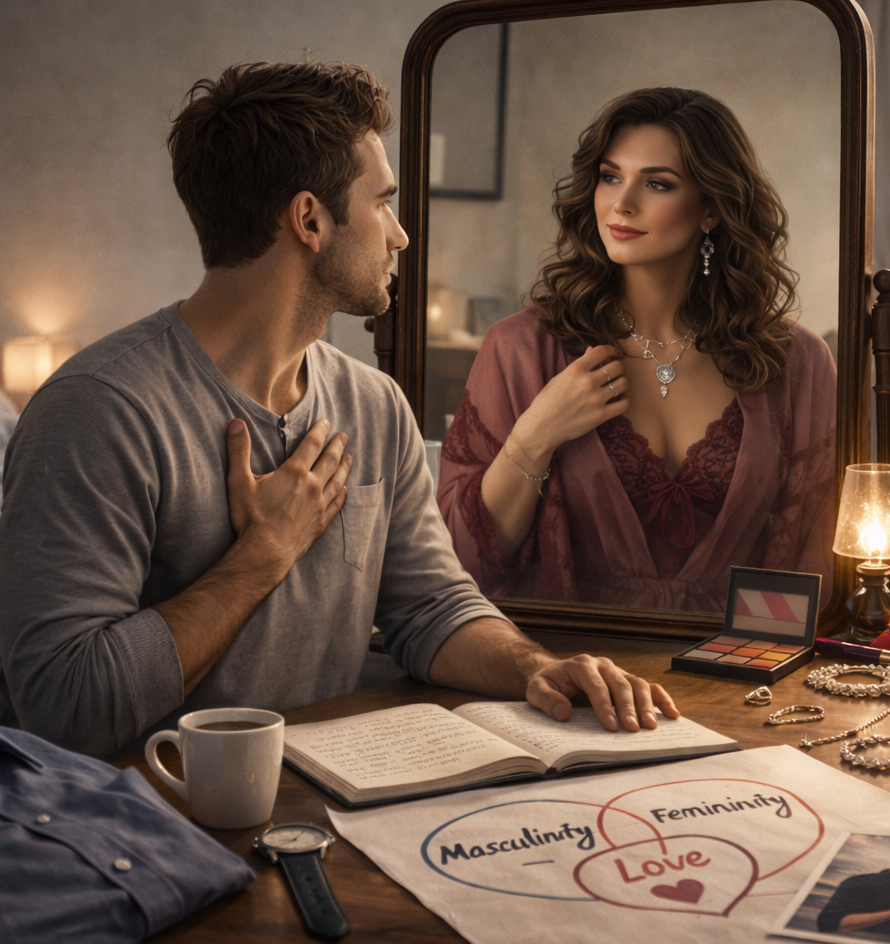 For many straight men who cross-dress, attraction and expression can feel like they exist on a collision course. On one side is a lifelong, deeply felt attraction to women—romantic, emotional, sexual, and relational. On the other is a powerful, often private desire to express femininity through clothing, presentation, and embodiment. While each of these experiences can feel authentic and grounding on its own, bringing them together can provoke confusion, guilt, and internal conflict.
Society offers a narrow script for straight male identity: masculinity is expected to be visible, consistent, and dominant; attraction to women is presumed to reinforce that masculinity; and femininity in men is frequently framed as either a joke, a fetish, or evidence of a hidden sexual orientation. For straight crossdressers, this script creates a painful paradox: If I love women, why do I want to dress like one? Or more quietly, Does dressing femme mean I’m not really straight—or not really a man?
It can take a critical analysis to try to understand that internal conflict. It requires exploring where these tensions come from, why they persist, and how many straight crossdressers eventually learn to reconcile masculinity, femininity, and attraction into a coherent, self-affirming identity.
The Cultural Myth: Masculinity as Proof of Straightness
From an early age, boys are taught that masculinity is both a performance and a credential. How you dress, walk, speak, and express emotion becomes evidence—not just of your gender, but of your sexual orientation. In this framework, attraction to women is assumed to require visible masculinity. The more traditionally masculine a man appears, the more his straightness is affirmed. Conversely, any expression of femininity is treated as suspicious.
For a boy who discovers an early fascination with women’s clothing, this creates an immediate fracture. He may admire women, desire women, and imagine himself in relationships with women—yet also feel drawn to the textures, silhouettes, and symbolic power of feminine dress. Because society rarely separates who you desire from how you express yourself, that boy learns to associate his interest in femininity with shame.
As he grows older, this association often deepens. Masculinity becomes something to be defended, especially in male-dominated environments. The straight crossdresser learns to compartmentalize: masculinity in public, femininity in private. Attraction to women is allowed daylight; dressing femme is pushed into secrecy.
This compartmentalization can last decades.
The Private Feminine Self: Sanctuary and Struggle
For many straight crossdressers, dressing femme is not about rejecting masculinity but about accessing something missing from their daily lives. It can feel calming, centering, and emotionally expansive. Slipping into a dress, skirt, or lingerie may quiet anxiety, soften self-criticism, and create a sense of wholeness that feels otherwise unreachable.
Yet this private sanctuary often carries an undercurrent of distress. Because femininity has been framed as incompatible with straight male identity, the act of dressing can trigger intrusive questions:
- What does this say about me?
- If my partner knew, would she still see me as a man?
- Am I betraying some essential truth about myself—or about her?
For men who deeply love and respect women, this conflict can be especially sharp. They may fear that dressing femme somehow undermines their attraction, or worse, trivializes or appropriates womanhood. Others worry that enjoying feminine presentation means they secretly want to be a woman, even if that idea doesn’t fully resonate.
These questions don’t arise because the desires are contradictory—they arise because society insists they must be.
Attraction vs. Identification: Untangling a Common Confusion
One of the most damaging cultural assumptions is that feminine expression in men must indicate a desire to identify as a woman or to be sexually attracted to men. While that is true for some people, it is far from universal.
Straight crossdressers often experience femininity as an aesthetic and emotional mode, not a declaration of identity. Dressing femme can be a way to explore vulnerability, beauty, receptivity, or softness—qualities that masculinity often discourages but does not negate.
Crucially, attraction operates independently. Loving women does not require rejecting femininity any more than loving men requires embracing it. The human psyche is capable of holding multiple, layered experiences at once.
For many straight crossdressers, the realization that expression is not orientation becomes a turning point. Femininity does not cancel attraction to women. In fact, for some, it deepens it.
Seeing Women More Clearly Through Femininity
An experience rarely discussed—but often privately acknowledged—is how dressing femme can increase empathy toward women rather than diminish respect. Wearing women’s clothing can heighten awareness of how bodies are perceived, judged, and constrained. It can illuminate the emotional labor involved in presentation and the vulnerability that often accompanies being seen as feminine.
For straight men who cross-dress, this awareness can foster a deeper appreciation for women as full, complex beings rather than abstract objects of desire. Attraction becomes layered with identification, curiosity, and emotional resonance.
Rather than wanting to replace women, many crossdressers describe wanting to understand them—sometimes through embodiment, sometimes through imaginative play, sometimes through shared aesthetic pleasure.
This does not negate masculinity. It enriches it.
The Relationship Fear: “Will She Still Want Me?”
Perhaps the most emotionally charged aspect of this internal conflict is the fear of romantic rejection. Straight crossdressers often worry that revealing their feminine side will make them less desirable to women, particularly to partners who value traditional masculinity.
This fear is not unfounded. Some women do struggle to reconcile a partner’s femininity with their own expectations of attraction. Others may interpret cross-dressing as deception or as a sign of instability.
But many women respond with curiosity, acceptance, or even attraction—especially when the disclosure is grounded in honesty rather than secrecy. For some couples, a partner’s femininity becomes a shared space of intimacy rather than a wedge.
The deeper issue is not whether all women will accept a feminine partner, but whether the crossdresser can accept himself enough to allow the possibility of being known.
Internalized shame often does more damage to relationships than femininity ever could.
Masculinity Reimagined: Strength Without Erasure
One of the most liberating shifts for straight crossdressers is redefining masculinity itself. Instead of seeing it as a fragile state that must be constantly defended, masculinity can be understood as a foundation—one that is strong enough to include softness, beauty, and play.
Masculinity does not vanish when a man wears a dress. It does not dissolve when he feels pretty, delicate, or emotionally open. In fact, choosing femininity in a culture that discourages it can be an act of quiet courage.
Many men find that their sense of masculinity becomes more secure once they stop policing it. The need to constantly perform toughness or emotional restraint eases. Attraction to women becomes less about proving straightness and more about authentic connection.
In this reframed view, masculinity and femininity are not opposing forces but complementary energies that can coexist within the same person.
Sexuality Without Apology
Sexual arousal often complicates the picture. For some straight crossdressers, dressing femme is erotically charged—especially in early experiences. This can intensify shame, as sexuality becomes entangled with taboo.
It’s important to recognize that sexual excitement does not invalidate emotional meaning. Many forms of self-expression begin with arousal before maturing into something broader. Over time, what once felt purely sexual may evolve into comfort, identity exploration, or creative expression.
Even when sexuality remains part of the experience, it does not negate attraction to women. Desire is not a zero-sum equation. Enjoying oneself in a feminine role does not diminish the capacity to desire, love, or commit to a woman.
The problem arises only when sexuality is treated as evidence of pathology rather than a natural response to intimacy with oneself.
Integration: Moving From Compartmentalization to Wholeness
The internal conflict many straight crossdressers experience is not resolved by choosing between masculinity and femininity, or between self-expression and attraction. It is resolved through integration.
Integration means allowing all parts of oneself to exist without hierarchy:
- The masculine self who loves women
- The feminine self who loves beauty and expression
- The private self who needs safety
- The relational self who longs to be known
This process is rarely quick. It often involves grief for years spent hiding, fear of social consequences, and careful negotiation within relationships. But it also brings relief.
When a man no longer sees his femininity as a threat to his straightness, both experiences become freer. Attraction becomes more relaxed. Expression becomes less urgent and less shame-driven.
Wholeness replaces secrecy.
Loving Women, Loving Self
Loving women while dressing femme is not a contradiction—it is a human complexity that challenges outdated definitions of gender and desire. Straight crossdressers are not confused, deceptive, or incomplete. They are navigating a cultural landscape that has failed to make room for nuance.
Reconciling masculinity, femininity, and attraction does not require abandoning any part of oneself. It requires questioning the assumptions that say these parts cannot coexist.
For those walking this path, the journey is less about choosing who to be and more about allowing who you already are to breathe. And in that space—where attraction is honest, expression is free, and identity is integrated—both love and self-acceptance have room to grow.
Comments
Loving Women While Crossdressing: Reconciling Masculinity, Femininity, and Attraction — No Comments
HTML tags allowed in your comment: <a href="" title=""> <abbr title=""> <acronym title=""> <b> <blockquote cite=""> <cite> <code> <del datetime=""> <em> <i> <q cite=""> <s> <strike> <strong>