
Invisible in the LGBTQ+ World: Why Crossdressers Don’t Quite Fit in Anywhere
 By Jenn der Bentson
There is a particular loneliness that comes from standing in a doorway and realizing it doesn’t quite open for you. You can see the room on the other side. You can hear the laughter, the shared language, the sense of belonging. But when you step forward, something catches. A label doesn’t fit. An assumption lands wrong. A glance lingers too long. You are not turned away outright—but you are not fully welcomed either.
For many heterosexual crossdressers, this doorway exists everywhere.
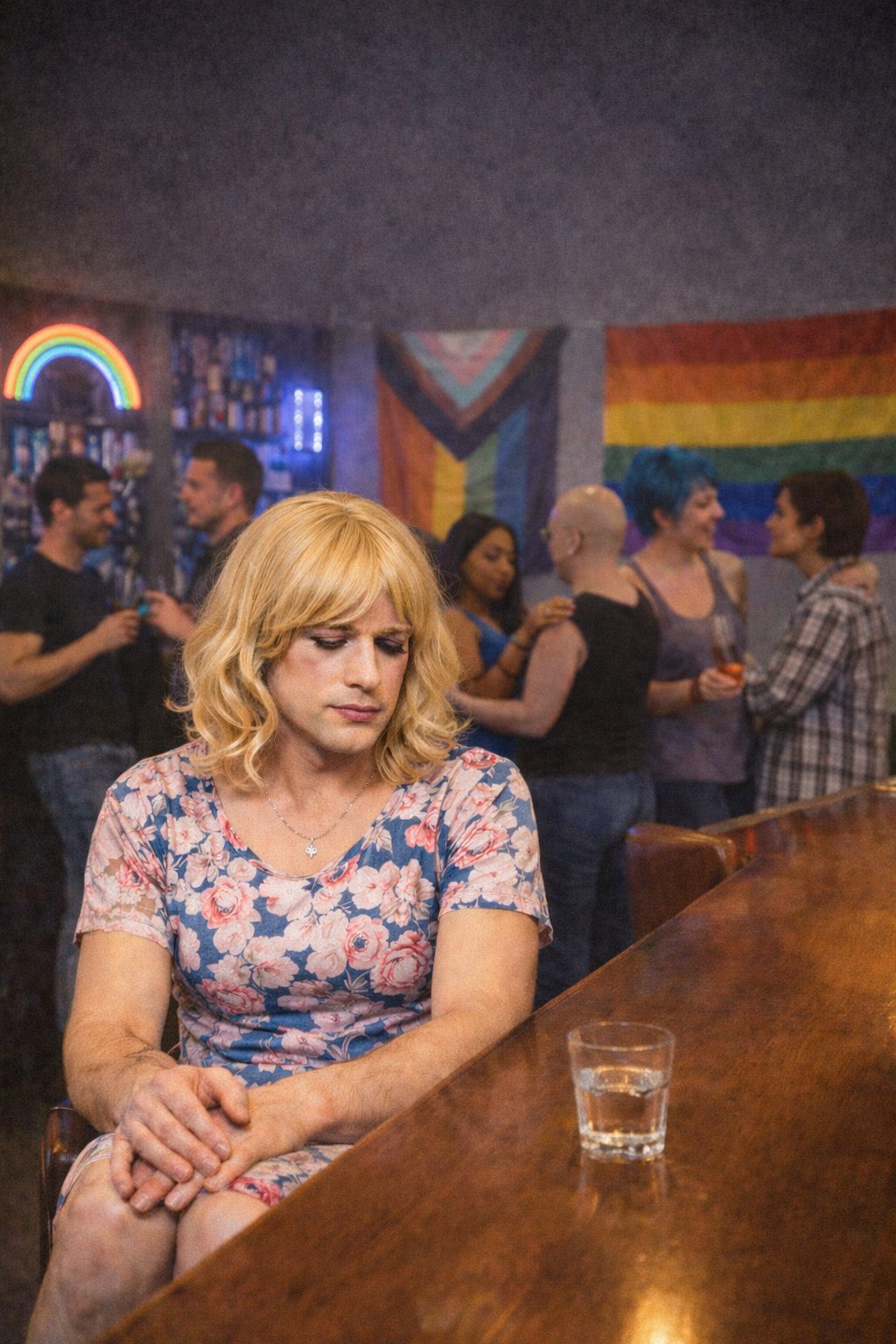
They are often invisible in straight spaces, where masculinity is narrowly defined and deviation is tolerated only as a joke, a secret, or a temporary costume. Yet they can also feel out of place in queer spaces, where gender nonconformity is widely embraced—but often assumed to be inseparable from sexual orientation or trans identity. The result is a peculiar and painful in-between: not quite fitting anywhere, not quite seen by anyone.
It is a liminal experience—how many straight-identified crossdressers navigate isolation, misunderstanding, and the ongoing search for community in a world that prefers clearer categories.
The Assumption Trap: “If You Dress Like This, You Must Be That”
One of the most common experiences heterosexual crossdressers describe is the exhaustion of constant explanation.
If a man enjoys wearing dresses, makeup, lingerie, or adopting a feminine presentation, many people—both straight and queer—immediately draw conclusions. He must be gay. Or bi. Or trans but in denial. Or “on the way” to something else. The idea that he could be a straight man who is simply expressing a feminine side is often treated as implausible or temporary.
In straight spaces, this assumption often carries threat. Crossdressing is read as a rejection of masculinity, which in turn is interpreted as weakness, deception, or sexual deviance. The response may range from ridicule to silence to outright hostility. Many heterosexual crossdressers learn early that safety depends on invisibility. They stay closeted not because they lack pride, but because the cost of honesty feels too high.
In queer spaces, the assumption takes a different form. There is often warmth, curiosity, and surface-level acceptance—but also an expectation that the crossdresser will “eventually” claim a queer identity. When he doesn’t, when he insists that his attraction remains oriented toward women, confusion or skepticism can arise. His presence becomes a puzzle that others want to solve rather than a reality to accept.
Over time, this constant misinterpretation creates a sense of erasure. Not rejection exactly—but a subtle refusal to believe someone when they tell you who they are.
Too Straight for Queer Spaces, Too Queer for Straight Ones
Many heterosexual crossdressers describe a recurring feeling: being welcomed conditionally.
In straight spaces, acceptance may exist only as long as the feminine expression remains hidden. A partner might know. A therapist might know. A few trusted friends might know. But public acknowledgment feels dangerous. The crossdresser is accepted as a man—as long as he performs manhood correctly most of the time.
In queer spaces, acceptance may exist as long as others can mentally place the crossdresser within familiar frameworks. He is welcomed as “gender nonconforming,” “questioning,” or “eggshell trans.” But when he asserts that his gender identity is male and his sexual orientation is straight, the warmth can cool. He doesn’t fit the narrative arc many expect.
This creates a painful paradox. The very spaces designed to challenge rigid gender norms can still struggle with people who disrupt their internal categories.
For heterosexual crossdressers, the question often becomes: Where do I belong if neither world fully sees me?
The Private Self and the Public Mask
Because of this ambiguity, many heterosexual crossdressers split their lives into compartments.
There is the public self: the husband, boyfriend, father, professional, “regular guy.” This self navigates straight society carefully, minimizing risk and maintaining credibility. Masculinity is performed not necessarily because it feels authentic, but because it feels necessary.
Then there is the private self: the woman inside, the feminine expression, the clothing, the name, the emotional openness that emerges when the mask comes off. This self often exists in bedrooms, hotel rooms, online forums, or rare safe spaces far from home. It may only surface occasionally, but when it does, it feels intensely real.
The tension between these selves can be exhausting. Living divided takes energy. It requires constant vigilance: Who knows? Who suspects? What can I say here? What must I hide?
In queer spaces, this division doesn’t always disappear. A heterosexual crossdresser might still feel pressure to explain why his feminine self is not a declaration of queerness. Instead of freedom, he encounters another performance—this time of justification.
Feeling Like an Impostor Everywhere
Impostor syndrome is often discussed in professional or academic contexts, but it is deeply familiar to many heterosexual crossdressers navigating identity spaces.
In straight environments, they may feel like frauds for presenting as “normal men” while knowing there is something significant they are hiding. Compliments on masculinity can sting. Locker room banter can feel alienating. Even love can feel conditional when it is based on an incomplete version of the self.
In queer spaces, the impostor feeling flips. The crossdresser may worry that he is appropriating gender nonconformity without “earning” it through queerness. He may hesitate to speak, fearing that his experiences will be dismissed as less valid, less political, less meaningful.
This constant self-policing erodes confidence. It teaches people to shrink rather than expand, to observe rather than participate. Over time, isolation becomes not just circumstantial, but internalized.
The Myth of the Linear Journey
One of the reasons heterosexual crossdressers can feel so out of place is that many narratives around gender expression are linear.
You start as one thing.
You question.
You transition.
You arrive somewhere else.
This story arc is comforting because it offers clarity and resolution. But not everyone’s experience follows that path.
For many straight crossdressers, femininity is not a stepping stone—it is a parallel track. They do not want to abandon their male identity. They do not necessarily want to transition. They do not feel “confused” about who they are attracted to. They simply experience themselves as layered.
Queer spaces, like straight ones, can struggle with nonlinearity. When someone doesn’t move forward toward a recognizable endpoint, others may assume they are stuck, repressed, or afraid. The possibility that someone might be complete while still contradictory is often overlooked.
Relationships and the Loneliness of Loving While Hidden
Romantic relationships add another layer to this sense of not fitting anywhere.
Heterosexual crossdressers who are partnered with women often fear being misunderstood not just socially, but intimately. Telling a partner can feel like risking everything: love, stability, family, future. Some partners are accepting, even enthusiastic. Others are tolerant but uneasy. Some are hurt, frightened, or unwilling to continue.
Even in accepting relationships, the crossdresser may feel alone. His experience does not neatly match his partner’s understanding of sexuality or gender. She may worry about what it “means.” He may struggle to articulate something he himself has spent years hiding.
Queer spaces can offer language, but not always resonance. Straight spaces can offer relatability, but not safety. The result is a deep longing for connection with people who simply get it—without needing explanation or translation.
Online Communities: Refuge and Reminder
For many heterosexual crossdressers, the internet becomes a lifeline.
Forums, subreddits, Discord servers, and private groups offer anonymity and understanding. Here, people share photos, stories, fears, triumphs. Here, no one blinks when someone says, “I’m straight, married, and love wearing dresses.” Here, femininity does not automatically come with an assumed destination.
But online spaces also highlight the problem. The fact that these communities are often hidden, fragmented, or transient reinforces the sense of invisibility. There are few public role models. Few cultural narratives. Few places to exist openly without explanation.
Digital connection helps—but it does not fully replace the human need to be seen in real life.
The Quiet Grief of Unnamed Identity
One of the most difficult aspects of this experience is that it is hard to name.
Heterosexual crossdressers often lack a widely recognized identity label that feels accurate and affirming. Existing terms can feel too narrow, too loaded, or too misunderstood. Without language, grief becomes amorphous.
There is grief for the self that could have been more visible.
Grief for friendships that might have been deeper.
Grief for community that exists in theory but not in practice.
Because this grief is rarely acknowledged, it is often carried alone. People may say, “At least you can pass.” Or, “At least you’re not persecuted like others.” While these statements may be factually true, they can invalidate real emotional pain.
Invisibility is not harmless. Being unseen does not mean being unaffected.
Toward a Broader Understanding of Belonging
So where does this leave heterosexual crossdressers?
For many, the answer is not in choosing a side, but in expanding the conversation. Belonging does not have to be conditional on fitting perfectly into existing categories. Gender expression does not have to be a proxy for sexual orientation. Identity does not have to be a journey with a predetermined destination.
Queer spaces have done enormous work in challenging binaries—but there is still room to grow in embracing complexity without assumption. Straight spaces, too, must learn that masculinity is not diminished by femininity, and that authenticity is not a threat.
Most importantly, heterosexual crossdressers themselves deserve permission to exist without apology. To claim space without justification. To seek community without having to translate their experience into someone else’s framework.
The Search for Community Is Not a Failure
Feeling out of place is not a personal failing. It is often a sign that existing structures are too rigid.
The search for community—for people who understand without explanation—is not evidence of confusion. It is evidence of self-knowledge. Many heterosexual crossdressers are not lost; they are simply underserved by the language and spaces currently available.
Belonging may come in small, imperfect forms: a trusted partner, a close friend, a local meetup, an online group that feels like home. It may come in moments rather than institutions.
And sometimes, belonging comes from recognizing that being “in between” is not emptiness—it is its own place to stand.
Being Seen, Even If Only by Each Other
Visibility does not always mean being loud or public. Sometimes it means being honest with oneself. Sometimes it means finding one other person who understands. Sometimes it means writing, sharing, or quietly saying, “Me too.”
Heterosexual crossdressers may feel invisible in both straight and queer worlds—but invisibility is not the same as nonexistence. Their experiences are real. Their identities are valid. Their longing for connection is human.
The world may not yet know exactly where to place them. But perhaps the answer is not to squeeze into a category, but to widen the doorway—so that more people can walk through without leaving parts of themselves behind.
Comments
Invisible in the LGBTQ+ World: Why Crossdressers Don’t Quite Fit in Anywhere — No Comments
HTML tags allowed in your comment: <a href="" title=""> <abbr title=""> <acronym title=""> <b> <blockquote cite=""> <cite> <code> <del datetime=""> <em> <i> <q cite=""> <s> <strike> <strong>