
Desire vs. Identity: Is Crossdressing a Fetish, a Need, or Both?
By Jenn der Bentson
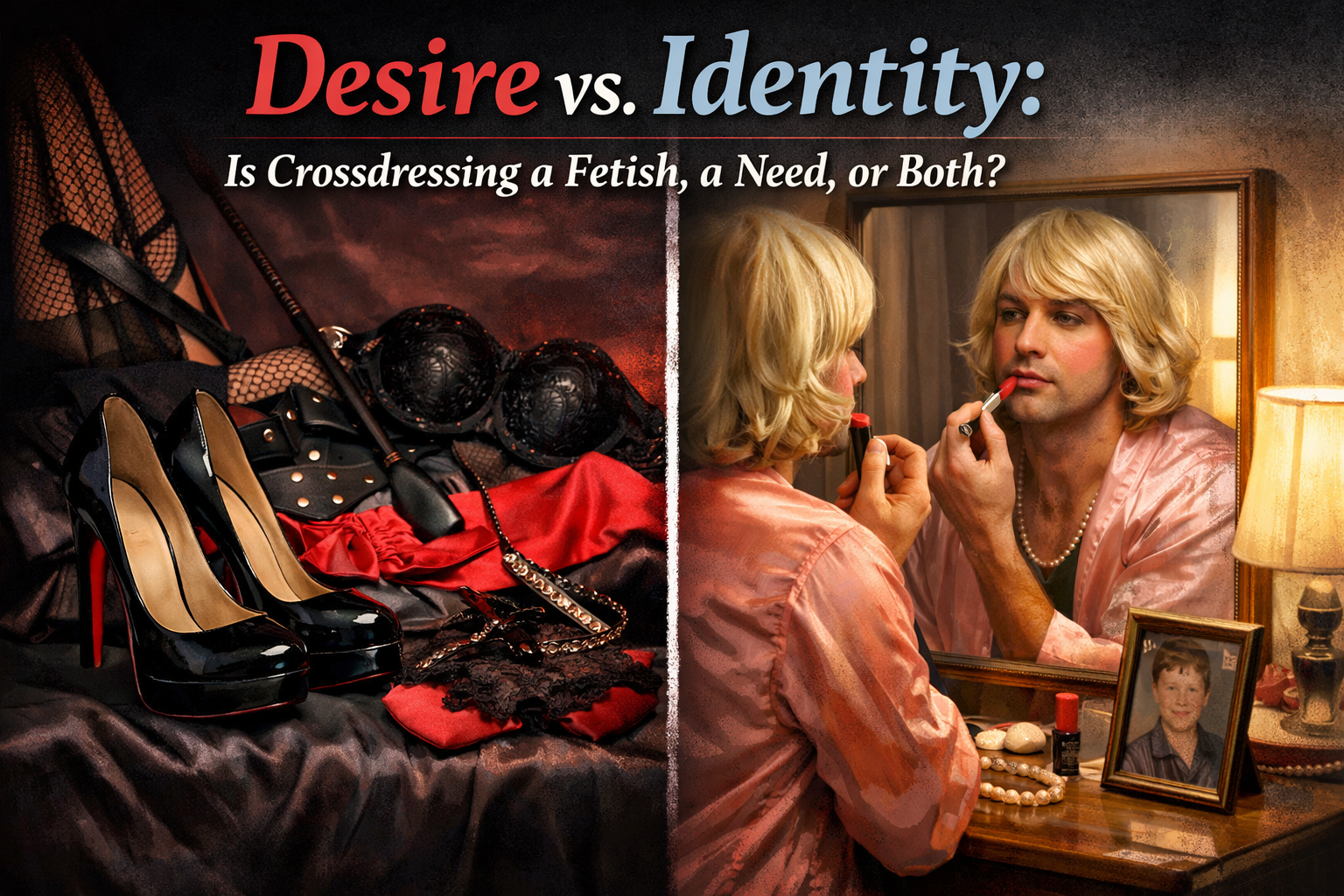 Crossdressing is one of those topics that often triggers oversimplified assumptions. Some people see it purely through a sexual lens—as a fetish. Others interpret it as a psychological or identity-driven expression—a need to present oneself in a way that aligns with inner self-understanding. The reality, however, is far more nuanced. For many who crossdress, the experience is both intensely personal and multifaceted: it can evoke sexual arousal, emotional satisfaction, psychological comfort, and profound self-expression all at once. Understanding these layers is essential—not just for those who crossdress, but for anyone seeking to appreciate the complex tapestry of human identity and desire.
The Spectrum of Motivation
When trying to understand crossdressing, it helps to recognize that motivations exist along a spectrum. At one end, crossdressing may be primarily sexual: garments, makeup, and the act of presenting in a different gender may produce arousal. This is often labeled as a fetish, and in some contexts, the term “transvestic fetishism” is used clinically. Yet, fetishistic behavior does not necessarily define the entirety of a person’s relationship with crossdressing. At the other end of the spectrum, crossdressing can be deeply tied to personal identity. For some, presenting as a different gender is a way to align their external appearance with their internal sense of self. This is not inherently sexual; it often provides comfort, self-affirmation, and a sense of authenticity.
Between these poles, countless individuals experience a mix of sexual arousal and identity affirmation. For them, crossdressing can be simultaneously arousing, emotionally satisfying, and integral to their psychological well-being. Recognizing that these motivations are not mutually exclusive is crucial for moving past stereotypes and judgment.
Desire and Arousal: The Erotic Dimension
It is no secret that clothing and gender presentation can have sexual connotations. Silk stockings, tailored dresses, or high heels—these objects can provoke desire, and the act of crossdressing can heighten sexual arousal. For some, the excitement comes from breaking gender norms or experiencing a taboo; for others, it’s the pleasure of embodying a gendered aesthetic they find sexually stimulating.
Sexual arousal, however, does not diminish the psychological or emotional significance of crossdressing. Arousal can coexist with—and even enhance—the sense of authenticity and self-expression. A man who enjoys wearing lipstick, for example, may feel sexual excitement while applying it, but the act might also make him feel more complete or aligned with his true self. Erotic pleasure and personal affirmation are not opposites; they are often intertwined.
Sexual excitement may ebb or flow over time. Someone who initially crossdresses primarily for sexual reasons may, over years, discover that the act brings profound emotional relief or identity alignment. Conversely, someone who crossdresses for identity affirmation might also find that sexual arousal naturally emerges. In both scenarios, acknowledging both elements is key to understanding the full picture.
Identity, Expression, and Emotional Necessity
While sexual aspects of crossdressing often attract attention, the emotional and psychological dimensions are equally critical. Many crossdressers describe a sense of “rightness” or relief when wearing clothes traditionally associated with another gender. This is not necessarily about sexual excitement—it is about self-expression, comfort, and authenticity.
For some, crossdressing functions as a psychological release. Daily life often demands conformity to gender norms, creating stress or anxiety for individuals whose internal sense of gender diverges from societal expectations. Dressing in alignment with their identity—even temporarily—can alleviate this tension and provide a vital sense of self-recognition.
Crossdressing also fosters creativity and exploration. Makeup, fashion, voice modulation, and mannerisms all become tools for expressing parts of oneself that might otherwise remain hidden. For some, this expression extends beyond private spaces: presenting publicly in a way that aligns with one’s identity can be deeply validating. These experiences underscore that crossdressing is not only about desire—it can also be about self-realization, artistry, and personal fulfillment.
When Desire Meets Identity
It is tempting to categorize crossdressing as either sexual or identity-driven, but this binary oversimplifies reality. Many people experience both simultaneously. A man might feel compelled to wear dresses not only because it arouses him but also because it allows him to feel more whole, more aligned with his identity. In this sense, crossdressing can be both a need and a source of desire—a dual-layered experience.
This intersection can be confusing, both for the person crossdressing and for observers. Friends, family, or partners may focus on sexual elements and dismiss the deeper emotional significance, or they may recognize identity needs but fail to acknowledge erotic aspects. Misunderstandings like these can be distressing, as they may invalidate one or both dimensions of the experience. For individuals navigating this intersection, clarity and self-reflection are essential. Journaling, therapy, or community support can help untangle motivations and foster understanding. The goal is not to force a single category—fetish or identity—but to accept the full spectrum of personal experience.
Societal Stigma and Gender Norms
Societal attitudes toward crossdressing significantly shape how individuals experience their desires and identities. Stigma often emphasizes the sexual dimension, portraying crossdressers as deviant or fetishistic, while minimizing or ignoring identity and emotional factors. This can leave people feeling isolated, ashamed, or compelled to hide aspects of themselves.
Rigid gender norms also amplify internal conflict. A man who finds comfort in skirts and makeup may struggle with feelings of inadequacy or shame if he interprets his desires as a threat to masculinity. Similarly, a woman who enjoys presenting in traditionally masculine clothing may fear judgment or loss of femininity. These pressures can make it challenging to reconcile desire and identity, even when both are healthy and consensual.
Encouragingly, communities both online and offline are increasingly recognizing the complexity of crossdressing. Spaces that welcome discussions of identity, eroticism, and expression without judgment can be transformative. For many, being able to articulate, explore, and validate both sexual and identity-driven motivations is profoundly liberating.
Healthy Exploration and Integration
For those navigating crossdressing, whether sexually, emotionally, or both, boundaries and self-awareness are key. Exploring personal motivations through reflection, journaling, or therapy helps individuals understand whether crossdressing feels primarily erotic, emotionally necessary, or both. Experimentation in private or controlled public spaces allows people to discover what clothing, makeup, and presentation styles feel authentic without pressure or judgment.
Communication is also crucial in intimate relationships. Partners may need reassurance, understanding, or education to navigate this multifaceted experience. Healthy exploration involves rejecting the notion that sexual enjoyment diminishes legitimacy. Erotic pleasure is a natural human response, and experiencing it in the context of crossdressing does not make the act frivolous, deviant, or less meaningful. Recognizing that sexual, emotional, and identity needs can coexist—and may even reinforce one another—fosters a more holistic, self-affirming approach.
Redefining “Normal”
One of the biggest obstacles to understanding crossdressing is the implicit assumption that people should fit neatly into categories: male or female, sexual or nonsexual, “normal” or “deviant.” In reality, crossdressing challenges these binary frameworks. Desire and identity often coexist, fluctuate over time, and resist simplistic labeling. Recognizing this complexity is a step toward self-acceptance and broader societal acceptance. People who crossdress are not merely enacting a fetish, nor are they simply satisfying a psychological need—they are exploring, expressing, and experiencing the full spectrum of human emotion and identity. Accepting this can foster compassion, reduce shame, and encourage dialogue.
Crossdressing cannot be neatly boxed into “fetish” or “identity need.” For many, it exists along a dynamic spectrum of desire, expression, and self-affirmation. Sexual arousal and psychological necessity often intersect, each enriching the other rather than diminishing it. Acknowledging this complexity allows individuals to explore their gender presentation with honesty, compassion, and pride.
Ultimately, crossdressing is about more than clothing: it is about discovering and embracing who one truly is. Whether that journey involves erotic pleasure, emotional relief, identity affirmation, or all three, it deserves understanding without judgment. Recognizing the interplay between desire and identity empowers crossdressers to live authentically and encourages society to see gender and self-expression as the beautifully complex, deeply human experiences they are. Crossdressing is not a secret, a shame, or a contradiction—it is a form of self-expression as rich and multifaceted as the people who embrace it. Desire and identity are not opposing forces; together, they illuminate the path to wholeness, authenticity, and self-love.
Comments
Desire vs. Identity: Is Crossdressing a Fetish, a Need, or Both? — No Comments
HTML tags allowed in your comment: <a href="" title=""> <abbr title=""> <acronym title=""> <b> <blockquote cite=""> <cite> <code> <del datetime=""> <em> <i> <q cite=""> <s> <strike> <strong>