
The Closet Within the Closet: The Hidden World of Straight Crossdressers
By Jenn der Bentson
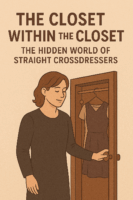 In a world increasingly defined by visibility, identity, and community, it’s easy to assume that everyone has a place, a tribe, or a label that fits. But for some, the space they occupy is murky, misunderstood, and lonely. Among these are heterosexual crossdressers—men who are emotionally and sexually attracted to women, but who also find joy, peace, and expression in presenting themselves in traditionally feminine ways.
They don’t identify as gay. They aren’t necessarily transgender. And yet, when dressed, they also don’t fit the mold of traditional cisgender masculinity. These men exist in a peculiar and often painful liminal space: a closet within the closet.
The broader LGBTQ+ community doesn’t always welcome them as kin, and traditional straight male spaces can be hostile or dismissive. The result? Isolation, confusion, and an aching hunger for connection.
There is a hidden world of straight crossdressers who have unique struggles, and feel the emotional toll of having no true place to belong.
The Misfit Identity: Too Straight for Queer Spaces, Too Queer for Straight Ones
Mainstream culture tends to operate in binaries. You’re either gay or straight. Male or female. Masculine or feminine. For heterosexual crossdressers, these dichotomies fall apart. A straight man in a dress defies expectations from both camps.
In LGBTQ+ spaces, there’s often a shared experience of queerness as tied to sexual orientation or gender identity. Many straight crossdressers don’t identify as queer in those ways—they are often content with their male bodies and are sexually attracted to women. Yet, their gender expression sets them apart, often confusing or alienating those around them.
On the flip side, in cisgender heterosexual male spaces, rigid definitions of masculinity dominate. Admitting to wearing women’s clothing can be social suicide, leading to mockery, emasculation, or even outright rejection. These environments prize traditional masculinity—strength, stoicism, dominance—and offer little space for men who derive comfort or self-expression from femininity.
And so, the straight crossdresser often finds himself homeless—not physically, but emotionally and socially. Too queer for the straight world, too straight for the queer world.
The Weight of Secrecy
One of the most agonizing realities of being a straight crossdresser is the persistent need for secrecy. From an early age, many learn to hide their feminine inclinations, often discovering crossdressing in childhood and keeping it hidden into adulthood. This secrecy isn’t simply a preference for privacy—it’s a survival strategy.
Fear looms large: fear of being misunderstood, rejected by loved ones, losing a job, or being perceived as deviant. Many heterosexual crossdressers are married or in long-term relationships with women, and the risk of disclosure can feel immense. Some carry the burden silently for years, even decades, before ever telling a partner—if they tell them at all.
This isolation becomes compounded by the inability to talk openly, even with close friends or family. What’s left is a rich inner life lived mostly in solitude. Dressing up becomes an intensely personal, private act—not unlike prayer or meditation—but tinged with guilt and longing.
Some find community in online forums, but even there, anonymity is prized. Real names and faces are rarely shared. This digital double life may offer temporary relief, but it often reinforces the feeling of being hidden, of living in the shadows.
Misunderstood and Misrepresented
Straight crossdressers frequently find themselves subject to misunderstanding. They’re often conflated with being gay or trans, neither of which may reflect their identity. This mislabeling isn’t malicious most of the time; it’s born of a lack of visibility and a culture unfamiliar with nuance.
Pop culture doesn’t help. Crossdressing in media is frequently a joke or a plot device. From Tootsie to Mrs. Doubtfire to White Chicks, the man-in-a-dress trope is typically played for laughs or disguise. Rarely is crossdressing portrayed as a valid form of identity or expression.
Even within trans discourse, crossdressers are sometimes seen as relics of an outdated narrative—people who haven’t “realized” they’re trans yet. While it’s true that some people discover they are trans through crossdressing, many are not on that path. Their experience is real and complete on its own terms, not merely a stepping stone to something else.
The result of all this? A constant need to explain, justify, or defend one’s identity—not just to others, but often to oneself.
Emotional Toll: Shame, Loneliness, and Mental Health
Living in this dual-layered closet takes a psychological toll. Many straight crossdressers experience deep shame—not because there is anything inherently wrong with their behavior, but because they’ve internalized societal messages that say there is.
Shame often morphs into anxiety, secrecy, and self-loathing. Some try to “purge”—throwing away their clothes and vowing never to dress again—only to find the urge returning like a wave. The cycle can be brutal: elation while dressing, followed by guilt, then resolve, then relapse.
Relationships suffer. How do you explain to a wife or girlfriend that you like to wear lingerie—not for sexual kicks, but because it feels like a truer, softer version of yourself? How do you risk her seeing you differently, less manly, less desirable?
Even therapists can be ill-equipped to understand this identity. Some pathologize it, while others lump it in with fetish behaviors. There’s a dire need for more psychological resources that affirm rather than stigmatize.
All of this can lead to depression, anxiety, and a crushing sense of loneliness. It’s one thing to be in the closet—it’s another to be in a closet so hidden that most people don’t even know it exists.
The Double Life: Navigating Two Worlds
For many straight crossdressers, life becomes a balancing act. They may work in traditionally masculine fields—engineering, law enforcement, construction—and come home to change into skirts and camisoles. They might be husbands and fathers who sneak moments of expression while the family is out of the house.
The duality is exhausting. It requires constant vigilance, creative hiding, and emotional compartmentalization. Some crossdressers become experts at masking, not just their identity but their emotions. They present as stoic, controlled, reliable—but underneath is a yearning to be seen as soft, delicate, beautiful.
This double life also leads to practical concerns. Where do you hide your clothes? How do you explain body shaving, or eyebrow grooming? What if your child finds your stash of wigs and heels?
Everyday life becomes a high-stakes game of cat and mouse—with the prize being safety, but the cost being authenticity.
Online Sanctuaries: The Blessing and Curse of Digital Community
With few offline options, many straight crossdressers turn to the internet. Platforms like Reddit, Discord, Flickr, and specialized forums like Crossdressers.com or Susan’s Place become lifelines. These spaces offer advice, solidarity, and a place to share photos without fear of judgment.
For some, these communities are transformative. They meet others who echo their feelings and struggles. They find friendship, mentorship, even romance.
But there’s a downside too. Online spaces can be echo chambers, or highly curated. They often skew toward performance—perfect makeup, flawless outfits, highly feminized personas—which can create pressure to conform or compete.
Moreover, the anonymity of the internet can become a crutch. It’s one thing to share your crossdressing online under a pseudonym; it’s another to be able to do it openly in the real world. Many crossdressers feel stuck—realizing they are still in the closet, even if they have hundreds of Instagram followers.
Small Acts of Courage: Toward Visibility and Self-Acceptance
Despite these struggles, many straight crossdressers are finding paths toward peace, acceptance, and even pride. Not everyone wants to come out publicly, but small steps—like telling a partner, joining a local support group, or simply looking in the mirror with love—can be radical acts of self-liberation.
Some are lucky to have accepting spouses who embrace this side of them. Others find kindred spirits in local LGBTQ+ spaces, even if the fit isn’t perfect. A few are carving out new communities altogether—dedicated to crossdressers of all orientations and identities.
These men are slowly pushing against the walls of the closet within the closet. They are reclaiming their identities, not as jokes or anomalies, but as valid expressions of masculinity, femininity, or something in between.
They are fathers who teach their children that beauty isn’t gendered. Husbands who find deeper intimacy through honesty. Professionals who recognize that leadership and vulnerability can coexist.
What Needs to Change
Society still has a long way to go in understanding and embracing crossdressing, particularly when it doesn’t align with tidy narratives. Here’s what needs to change:
- Language: We need better, broader terms to describe the diversity of male gender expression without assuming sexual orientation or gender identity.
- Representation: Media should move beyond caricatures and show straight crossdressers as real, nuanced people.
- Education: Therapists, educators, and even HR departments need training to understand this identity and offer appropriate support.
- Community: More inclusive spaces—both online and offline—need to exist for straight crossdressers to connect and be seen without having to justify themselves.
The Closet Isn’t Inevitable
The “closet within the closet” is real—but it doesn’t have to be permanent. As society slowly evolves toward greater acceptance of gender fluidity and expression, the hope is that straight crossdressers will no longer be forced into isolation simply for being who they are.
It starts with visibility. With honest conversations, like this one. With blogs and books, with whispered confessions that become confident declarations. With the realization that being a straight man who loves femininity isn’t a contradiction.
There is strength in softness. There is dignity in duality. And there is beauty—profound, radiant beauty—in being your whole self.
Hi, I just discovered your site. Thank you for an excellent personal and community resource. It addresses many difficult and sensitive emotional issues well with practical, helpful, insightful advice. I’m interested in your opinion of the 2014 French movie “The New Girlfriend” by Francois Ozon. I recently watched it for the first time. And then a few more times, closely. I found it a unique (to me) in its portrayal of sympathetic central and supporting characters, and with an ending different from the usual stereotypes of a movie crossdresser as the warped villain, a comic role, or an unhappy, twisted person, etc. I found it very effective and enjoyable, but its impact almost traumatic/cathartic on first watch. So with this blog on a related topic, I’m interested in your reaction to the movie, if you’ve seen it. Thanks, and keep going!!
I have not seen it, will endeavor to do so!