
Masculinity and Makeup: Redefining Manhood as a Crossdressing Straight Man
By Jenn der Bentson
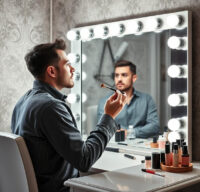 In a world that increasingly embraces fluidity and authenticity, some of the most difficult, personal, and profound transformations are happening not on stages or in politics—but in bedrooms, closets, and mirrors. For many heterosexual men who crossdress, the intersection between masculinity and makeup isn’t just cosmetic; it’s a confrontation with decades—if not centuries—of rigid expectations about what it means to be a man.
This discussion is for the guys who feel the electric thrill of eyeliner, the grounding calm of a dress swishing around their legs, the affirmation in a padded bra—and who wrestle with what that means about their identity. It’s also for those who love them, want to understand them, or perhaps are just curious about how gender expression collides with masculinity in the context of a straight man who crossdresses.
Let’s talk about it: the lipstick, the lashes—and the legacy of masculinity.
The Problem with the “Man Box”
Society tends to build boxes for people. For men, especially straight men, the box is called “masculinity.” It includes expected behaviors like strength, stoicism, dominance, heterosexuality, independence, and, critically, the suppression of anything coded as “feminine.”
For decades, this box was rigid. Boys were told not to cry. To play rough. To like cars, not dresses. To see femininity as weakness, or at best, “something for girls.”
But inside that box, a lot of men couldn’t breathe.
Crossdressing is, for many straight men, a quiet rebellion. It’s not just an aesthetic choice—it’s a declaration of complexity. Yet it often comes with intense internalized shame. Many crossdressers have asked themselves: “Am I still a man?” “What if someone finds out?” “Does this mean I’m gay?” These questions are not about gender identity or sexual orientation, but about how deeply embedded masculinity norms are.
The real tragedy isn’t that some straight men wear dresses; it’s that they feel they have to hide, apologize, or explain their joy.
Masculinity vs. Gender Expression: Untangling the Wires
Let’s get this out of the way early: crossdressing does not equal being transgender, gay, or confused. Crossdressing, for many heterosexual men, is a form of gender expression, not gender identity. A crossdresser might identify completely as a man but enjoy presenting a feminine side—sometimes, often, or occasionally. It’s a way of exploring different facets of self.
Yet the act of crossdressing—putting on a bra, shaving one’s legs, applying foundation—collides with how society defines masculinity. Straight men who crossdress often wrestle with what they were taught it means to be a man. The shame, secrecy, and confusion come not from the clothes themselves, but from inherited beliefs that femininity and manhood can’t coexist.
But they can. And do. All the time.
Makeup and masculinity are not opposites. They never were. But our cultural narratives say otherwise.
The Fear of Being Misunderstood
One of the greatest struggles for straight male crossdressers is fear—fear of being labeled, of being misunderstood, or of losing the respect of loved ones. This fear doesn’t arise in a vacuum.
Our society heavily sexualizes crossdressing, especially when men do it. The default assumption is that a man who enjoys wearing women’s clothing must be either gay, trans, or fetishizing women. While some crossdressers do find erotic energy in the act, for many others, it’s about comfort, self-expression, emotional release, and connection to a more vulnerable part of themselves.
The truth is that gender expression is diverse. Wearing a dress doesn’t mean you want to be a woman. Enjoying makeup doesn’t mean you’re not masculine. These false equivalencies are exactly what need to be dismantled.
Makeup as Mirror: The Emotional Side of Feminine Expression
For many male crossdressers, makeup is more than color on skin—it’s a portal. Each brushstroke is a small act of transformation, not into someone else, but into a fuller version of self.
Why? Because femininity, for many straight men, is a locked room they’ve never been allowed to enter. When they finally do, they often find beauty, peace, and emotional expression waiting for them. It’s liberating—and scary.
Makeup, in this sense, is not a mask. It’s an unveiling. A way to see oneself differently and feel differently, without losing the core of one’s identity.
Many crossdressers describe feeling more relaxed, empathetic, or emotionally open when dressed. This isn’t because their male selves are false, but because their feminine selves are often denied full access to the world. In private, that changes.
So why the internal conflict?
Because these emotions have been culturally labeled “unmanly.” The joy that comes from putting on lip gloss or heels clashes violently with the societal programming that told these men to be tough, hard, and emotionally armored. The dissonance can be overwhelming.
Redefining What It Means to Be a Man
What if masculinity didn’t mean rejecting femininity—but incorporating it?
This is the challenge and the opportunity for straight male crossdressers: to rewrite the definition of manhood in a way that allows makeup and muscle, eyeliner and honesty, skirts and strength.
Being a man doesn’t require proving you’re not feminine. In fact, the strongest men are often those who can embrace their full humanity—vulnerability, sensitivity, creativity—in ways that go beyond the binary.
We don’t need new boxes. We need to destroy the old ones.
Being a man who crossdresses isn’t a contradiction. It’s a challenge to the idea that masculinity is so fragile that a pair of heels could break it.
The Role of Partners, Friends, and Society
Coming out as a crossdresser to a partner is one of the most difficult steps many straight men face. And it makes sense—there’s fear of rejection, fear of being seen as less masculine, fear of not being “wanted” anymore.
Partners, too, struggle. Many women have been taught that men who wear makeup must be queer or hiding something. Others fear what it means for their relationship or sexual dynamics. These concerns are real—but they are also often based on outdated assumptions.
Honest conversations are essential. So is patience. When a man says, “I enjoy wearing women’s clothes,” he’s not saying, “I want to be a woman,” or “I don’t love you,” or “I’m not the man you thought I was.” He’s saying: “There’s more to me than you’ve seen.”
Friendships, too, may be tested. Telling a male friend you crossdress can evoke everything from awkward silence to frat-boy jokes to deep support. You’ll find out quickly who is truly open-minded—and who only pretends to be.
But here’s the thing: every time a man says out loud, “Yes, I’m straight, and I wear makeup sometimes,” the narrative changes. Every time he walks confidently through that contradiction, another wall of shame comes down.
From Shame to Pride: A Personal Journey
For many crossdressing straight men, the arc is similar. It begins with curiosity—trying on mom’s heels or a sister’s dress. Then comes guilt, secrecy, shame. Years may pass in hiding. But eventually, the pull becomes too strong to ignore.
Some men purge their feminine clothing, vowing never to go back. But they always do. Why? Because it’s not just about clothes. It’s about being whole.
Eventually, many arrive at a place of balance. They integrate their masculine and feminine sides. They stop apologizing. They stop hiding. Some tell their wives. Some tell no one. But the shame lessens, and authenticity grows.
The journey from internalized homophobia and gender rigidity to self-acceptance is one of the bravest things a man can do.
And it begins with permission—from oneself.
Masculinity, Makeup, and the Future
So where do we go from here?
We create space. We tell stories. We normalize the complexity of men who enjoy things that society told them weren’t “for them.”
Masculinity isn’t dying—it’s evolving. And the next version might include eyeliner, empathy, and a damn good smoky eye.
Straight men who crossdress are part of that evolution. They are pioneers in a quiet, powerful movement that challenges the very idea of what “manly” means.
And the more we talk about it, the more we realize: gender is a spectrum. Expression is art. And masculinity—true masculinity—can hold space for softness.
If you are a man who enjoys wearing feminine clothes, and you’re reading this with a lump in your throat, know this: you’re not broken. You’re not weird. You’re not alone.
You are redefining what it means to be a man.
Masculinity isn’t about denial. It’s about strength—sometimes the strength to be vulnerable, to be authentic, to wear what you love and love who you are.
So wear the makeup. Own the heels. Embrace the contradiction. Be the kind of man who doesn’t shrink to fit in a box.
Be the kind of man who expands to become whole.
Comments
Masculinity and Makeup: Redefining Manhood as a Crossdressing Straight Man — No Comments
HTML tags allowed in your comment: <a href="" title=""> <abbr title=""> <acronym title=""> <b> <blockquote cite=""> <cite> <code> <del datetime=""> <em> <i> <q cite=""> <s> <strike> <strong>