
You Don’t Have to Be a Democrat to Rock That Dress: Crossdressing and the Republican Embrace of Personal Freedom
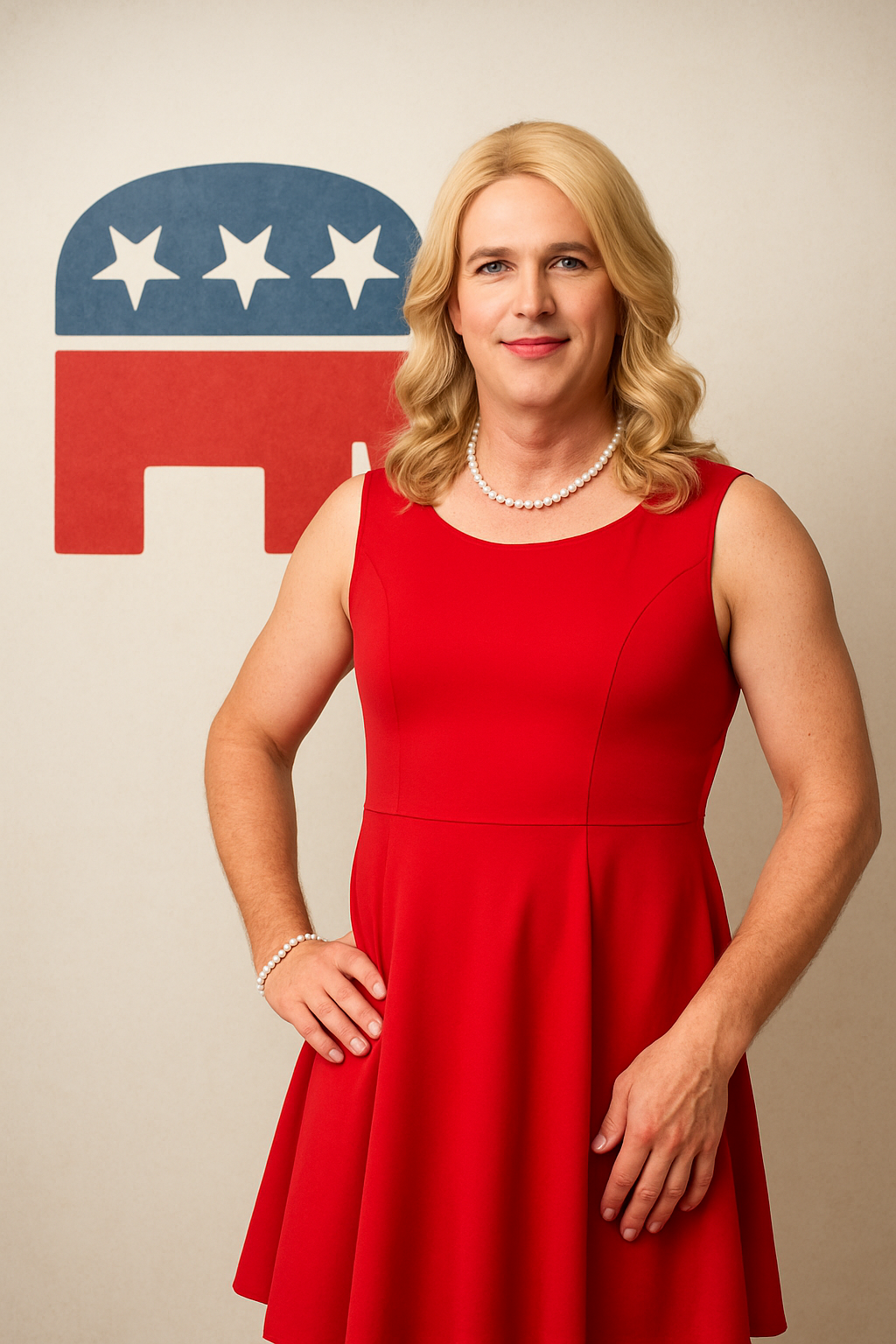 by Jenn der Bentson
Hey there, fellow fashion rebels and skirt enthusiasts! If you’ve ever slipped into a pair of heels or twirled in a sundress and felt that rush of authenticity, you know crossdressing isn’t just about clothes—it’s about owning who you are in a world that loves to box us in. But here’s the elephant in the room (or should I say, the wig on the vanity): the assumption that to embrace your feminine side, you must align with Democratic politics. That crossdressing is some liberal rite of passage, and if you’re waving a red hat at rallies, you’re somehow betraying your inner diva. Nonsense! Today, I’m here to shatter that myth and remind you that personal freedom—the beating heart of crossdressing—thrives just as much, if not more, under Republican values. You can be a crossdresser, love your local GOP meetup, and still strut your stuff without apology.
Let’s set the stage. In the wake of the 2024 election, with Donald Trump back in the White House, the media narrative has been relentless: this administration is “anti-trans,” hostile to anyone blurring gender lines, and basically out to ban dresses from the wardrobe of anyone who isn’t cookie-cutter traditional. Headlines scream about bathroom bills, sports bans, and school policies, painting Republicans as the villains in a drag queen story hour gone wrong. But peel back the layers, and you’ll find something far more nuanced. The current administration—and the Republican center at large—isn’t gunning for your lingerie drawer. They’re focused on bigger fish: economic stability, border security, and keeping government out of your personal business. Crossdressing? That’s your lane, your life, your choice. As long as you’re not demanding the world rearrange itself around your preferences, they couldn’t care less.
Think about it. The core Republican philosophy boils down to individual liberty: you do you, I’ll do me, and let’s keep the nanny state at bay. That’s not code for conformity; it’s a shield for eccentricity. History is littered with conservatives who’ve bucked norms in private while championing freedom in public. Ronald Reagan, the Gipper himself, was all about small government and personal responsibility—principles that let you experiment with eyeshadow without Big Brother’s oversight. Fast-forward to today, and Trump’s administration has doubled down on deregulation. No federal mandates forcing schools to affirm every whim, no top-down decrees on pronouns or parades. That’s freedom, pure and simple. If you want to crossdress at home, at a club, or even in your backyard BBQ (as long as the neighbors don’t mind), go for it. Republicans aren’t storming your closet; they’re storming the bureaucracy that’s tried to politicize everything from your thermostat to your tights.
But why does this misconception persist? Part of it is the echo chamber effect. Social media amplifies voices that equate any boundary-setting with bigotry. If a state passes a law protecting women’s sports from biological males, suddenly it’s “anti-trans” Armageddon. Yet, for the average crossdresser who’s not competing in athletics or seeking puberty blockers for kids, this doesn’t touch your world. The administration’s priorities—slashing inflation, boosting energy independence, and restoring law and order—leave ample room for personal expression. I’ve chatted with crossdressers in red states who say it’s liberating: no pressure to “come out” politically, just the quiet joy of slipping into silk without fanfare. One guy I know, a logistics manager in Texas, votes Republican every time and keeps his en femme photos private. “Government’s for roads and defense,” he told me. “My wardrobe’s off-limits.” That’s the Republican center: live your truth, but don’t legislate mine.
Now, let’s dive deeper into why personal freedom is the unsung hero of crossdressing. At its essence, crossdressing is rebellion against rigidity—a celebration of fluidity in a scripted society. Republicans get that. Their emphasis on the Second Amendment, free speech, and entrepreneurship stems from the same root: empowering individuals over collectives. You want to start a crossdressing support group? Launch a blog like this one? Sell handmade gowns online? Republican policies foster that entrepreneurial spirit. Tax cuts under Trump 2.0 mean more money in your pocket for that new corset. Deregulation opens doors for small businesses, including those catering to niche communities. Contrast that with heavy-handed regulations that could stifle innovation—remember how some blue states piled on fees and permits for “alternative” events? Freedom isn’t just a buzzword; it’s the oxygen for self-expression.
Of course, the flip side is key: don’t push your choices on others. That’s where Republican centrism shines. Live your life authentically, but respect that not everyone shares your journey. Forcing schools to teach gender ideology or mandating pronoun usage? That’s overreach, and it’s why many conservatives push back—not out of hate, but to preserve choice for all. If you are reading this as a crossdresser, you know the thrill of voluntary acceptance over coerced tolerance. I’ve seen it firsthand: at conservative-leaning meetups, folks might raise an eyebrow at first, but if you’re genuine and unobtrusive, doors open. One story that sticks with me is from a crossdresser in Florida who joined a local Republican women’s auxiliary (yes, en femme). She bonded over shared values like family and faith, and her unique style became a non-issue. “They care about my character, not my hemline,” she said. That’s personal freedom in action—no virtue-signaling required.
Let’s address the elephant—or should I say, the administration’s stance head-on. Sure, there are policies targeting extreme cases: protecting kids from irreversible decisions, ensuring fairness in women’s spaces. But for adult crossdressers minding their business, it’s crickets. Trump’s team has reiterated that private adults consenting to their own lives is fine—echoing the libertarian streak in the GOP. Vice President Vance has spoken about balancing compassion with common sense, not eradication. And let’s not forget the quiet conservatives who’ve always been there: think of the military vets who crossdress post-service, valuing discipline and discretion alongside their femininity. The current admin supports veterans’ mental health without prescribing lifestyles, allowing space for diverse coping mechanisms.
Media bias plays a huge role in the “anti-everything” narrative. Outlets lean left, framing any restraint as regression. But dig into actual policies: no nationwide dress code, no IRS audits for skirt purchases. Instead, focus on meritocracy—where your talents, not your attire, define you. For crossdressers in professional fields, that’s gold. Imagine thriving in tech or finance, Republican-backed innovation fueling your side hustle in fashion design. Personal stories abound: a software engineer in North Carolina who codes by day, crossdresses by night, and credits red-state freedoms for his peace. “No one’s policing my weekends,” he shares. “That’s liberty.”
Expanding on this, consider the cultural angle. Republican centrism isn’t puritanical; it’s pragmatic. They celebrate American individualism—pioneers, cowboys, mavericks—who defied norms. Crossdressing fits that mold: forging your path against societal scripts. Parties like CPAC have hosted diverse speakers, proving ideology trumps identity politics. You can admire Reagan’s charisma while channeling Marilyn Monroe. It’s not hypocrisy; it’s wholeness. And in an era of cancel culture, Republican emphasis on free speech protects your right to post en femme pics without fear—unless you’re harassing others, of course.
But what about the trans overlap? Not all crossdressers identify as trans, and conflating them muddies waters. Many enjoy the aesthetic without transition, and Republicans respect that distinction. Policies safeguard against medicalizing minors but leave adults autonomous. One crossdresser I interviewed, a lifelong Republican, said, “I dress for joy, not ideology. Government’s role ends at consent.” That’s the point: your life, your rules, no impositions.
Critics claim Republicans want a 1950s rollback. Baloney. Trump’s first term saw drag shows flourish; no federal crackdown. Today, with economic wins, folks have more leisure for hobbies like ours. Personal freedom means pursuing happiness your way—be it hunting, knitting, or nail polish. Republicans champion that pluralism without the equity quotas that sometimes sideline individuals.
On pushing boundaries, the ethos is live and let live. Republicans embody this by opposing forced inclusivity—like DEI mandates that prioritize identity over merit. As crossdressers, I would think we want genuine acceptance, not pity hires. Freedom allows organic bonds, like the conservative dad who crossdresses privately, raising kids with values of self-reliance.
Economically, Republican policies empower. Lower taxes mean affording therapy, wigs, or vacations en femme. Deregulation boosts gig economy for makeup artists or stylists in our community. It’s practical liberty.
For younger readers: conservatism evolves. Gen Z Republicans blend tradition with tolerance—think podcast hosts discussing fluidity sans dogma. Crossdressing aligns with their anti-woke stance: authenticity over activism.
Challenges exist—family pushback, workplace norms—but Republican values arm you: resilience, privacy rights. Courts under this admin uphold free association, protecting meetups.
Don’t just buy into the Democrat default positions. They don’t take into account what real Republicans want. Freedom and personal authority. Crossdressing is apolitical at heart, amplified by Republican personal freedom. Be you, unapologetically, without foisting on others. The center-right invites eccentrics who value liberty. Strut on, sisters—red, white, and you.
Comments
You Don’t Have to Be a Democrat to Rock That Dress: Crossdressing and the Republican Embrace of Personal Freedom — No Comments
HTML tags allowed in your comment: <a href="" title=""> <abbr title=""> <acronym title=""> <b> <blockquote cite=""> <cite> <code> <del datetime=""> <em> <i> <q cite=""> <s> <strike> <strong>