
Digital Privacy Techniques for a Crossdresser: Safeguarding Your Femme Persona in the Online World
by Jenn der Bentson
 In an era where our lives are increasingly intertwined with the digital realm, privacy has become a precious commodity. For crossdressers, the stakes are even higher. Exploring your femme side online can be liberating—connecting with communities, sharing experiences, and discovering resources that affirm your identity. However, without proper precautions, your digital activities can leave a trail that might expose your personal life to unwanted scrutiny, whether from family, employers, or even malicious actors. So let’s dig into some practical, actionable techniques to minimize your trackable digital footprint while embracing your crossdressing journey. It is important to focus on creating a separate online existence for your femme persona, ensuring it’s as disconnected as possible from your everyday identity. By treating this as a “cover persona,” you can enjoy the freedom of expression without compromising your safety.
The goal here isn’t paranoia; it’s empowerment. With data breaches, targeted advertising, and surveillance becoming commonplace, crossdressers often face unique vulnerabilities. A single slip—like using your real email for a forum post or sharing a photo with metadata—could link your femme activities back to you. According to privacy experts, over 80% of online users underestimate how much data companies collect, from browsing habits to purchase histories. For someone navigating gender expression, this can lead to outing, discrimination, or harassment. But fear not: by implementing the strategies outlined below, you can build a robust digital shield. We’ll cover everything from email setup to secure shopping, emphasizing diligence in keeping your worlds separate. Remember, consistency is key—think of your femme persona as a distinct character in a story, with its own backstory and boundaries.
Establishing a Foundation: The Separate Email Address
The cornerstone of your digital privacy strategy is a dedicated email address for your femme persona. This isn’t just any throwaway account; it’s the gateway to your online activities, ensuring that nothing ties back to your primary email, which is likely linked to your real name, work, or social circles.
Start by choosing a privacy-focused email provider. Services like ProtonMail or Tutanota offer end-to-end encryption, meaning your messages are secure from prying eyes, including the provider itself. Gmail works well also; you will likely have to input an alternate recovery email or phone number associated with it, but it is generally secure and enough of a gap that it won’t connect your accounts where you use the new email address you set up. These are free for basic use and don’t require personal information to sign up—perfect for anonymity.
When creating the account, invent a username that reflects your femme identity but avoids anything too revealing. For example, something like “ElegantEve2025@protonmail.com” works well—feminine yet generic. Use a strong, unique password and enable two-factor authentication (2FA) if you want to go another set instead of SMS, which can be intercepted. You might even go as far as to set up a google voice number or something similar.
Why is this separation crucial? Your primary email is a hub for bills, subscriptions, and communications that reveal your real identity. By using a femme-only email, you create a firewall. Sign up for all crossdressing-related accounts—Reddit, X (formerly Twitter), forums like Crossdressers.com, or shopping sites—exclusively with this address. This way, if a data breach occurs on one platform, it won’t cascade to your personal life.
To enhance security, you might choose to access this email only through secure methods. Many choose to use a VPN (Virtual Private Network), making it harder for trackers to pinpoint your location. VPNs encrypt your internet traffic, routing it through servers worldwide. Opt for paid services with no-logs policies, verified by independent audits. Free VPNs often sell your data, defeating the purpose.
In practice, log into your femme email during dedicated sessions, perhaps on a separate device or browser profile. This compartmentalization prevents cross-contamination—imagine accidentally replying to a work email from your femme account. Over time, this email becomes the nucleus of your secondary persona, handling newsletters from crossdressing blogs, community invites, and even password resets for related accounts.
Embracing Private Browsing: Your First Line of Defense
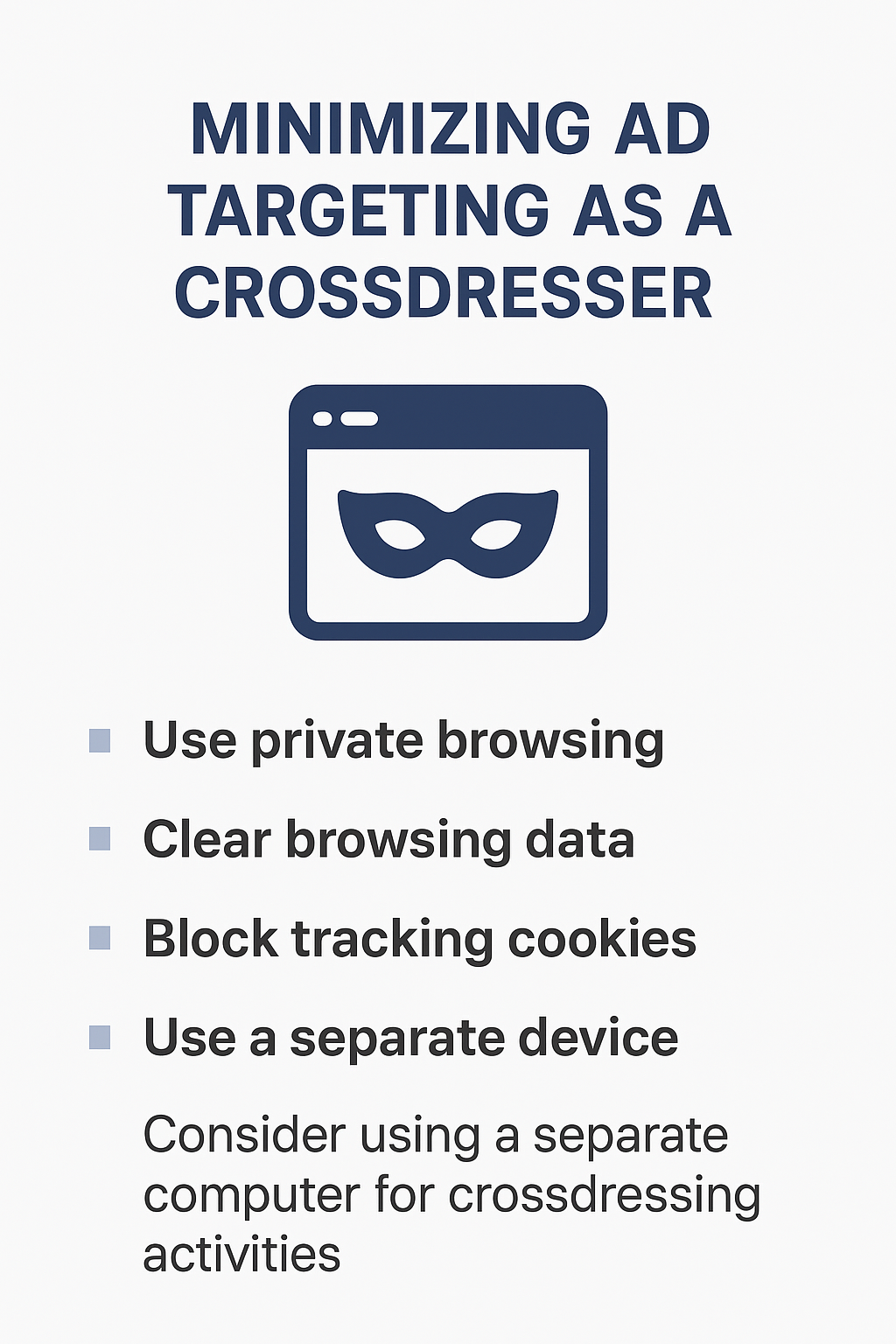 Once your email is set up, the next step is to navigate the web without leaving breadcrumbs. Private browsing modes, available in browsers like Chrome (Incognito), Firefox (Private Window), or Brave, are essential tools. These modes don’t save your history, cookies, or site data after you close the window, reducing the risk of trackers building a profile on you.
However, private mode alone isn’t foolproof—it doesn’t hide your IP or prevent websites from logging your visits. Pair it with extensions like uBlock Origin for ad-blocking and Privacy Badger to stop trackers. For ultimate privacy, consider the Tor Browser, which routes your traffic through multiple nodes, anonymizing your connection. Tor is free and ideal for sensitive searches, like “best breast forms for beginners,” without linking them to your identity.
Think of private browsing as your stealth mode. For crossdressers, this means researching makeup tutorials, wig styles, or hormone resources without fear of targeted ads popping up on your main computer. One user shared anonymously on a forum: “Switching to private mode changed everything—I no longer get awkward recommendations on my work laptop.” By making this a habit, you ensure your explorations remain confined to your femme world.
A big important part of private browsing is that the cookies in your browser aren’t tracking associated with your regular profiles. This will keep advertising from showing you women’s clothing all the time in your ads on your other accounts. Clearing your private browsing cache in your browsers is also a good thing to do regularly to keep this to a minimum. You might even work to keep your “femme” internet activities to one device that only uses those accounts. This can keep cross advertising from transitioning to other devices such as tables or phones.
Crafting a Secondary Persona: The Art of Disconnection
To truly stay anonymous, build a comprehensive secondary persona. This isn’t about deception; it’s about protection. Treat it like a cover identity in espionage—completely disconnected from your real life, with its own details and habits.
Start with basics: Choose a femme name that’s common yet personal, like “Sophia Rivers.” Invent a backstory—perhaps she’s a 30-something artist from a vague location like “the Midwest.” Never use your actual birthdate; pick one that’s plausible but unrelated, say, April 15, 1990. For location, use a generic one like “USA” or a large city far from yours, but avoid specifics that could be cross-referenced.
This persona extends to all online interactions. When signing up for Reddit (e.g., r/crossdressing or r/MtF), use your femme email and fabricated details. On X, create a handle like @SophiaInSilk, posting under this identity only. Forums and Discord servers for crossdressers often require minimal info, but stick to your persona’s script.
Keeping practices separate is non-negotiable. Use a dedicated browser profile or even a virtual machine (via software like VirtualBox) for your femme activities. This isolates cookies, extensions, and history.
Why go this far? Digital footprints are insidious. Algorithms connect dots—your IP, device ID, even typing patterns. A secondary persona breaks these links. If questioned, your real self has no ties. It’s empowering: “My femme side is free to express without judgment,” as one community member put it.
Navigating Social Media and Forums Safely
Social platforms are double-edged swords for crossdressers—great for support, risky for exposure. Always sign up with your femme email and persona details. On Reddit, join subreddits anonymously; avoid posting from your main account. Use throwaway accounts for sensitive shares.
For X, enable privacy settings: Make your account private, limit who can see posts, and disable location tagging. Engage in communities like #Crossdressing or #TransFem, but vet interactions—scammers target vulnerable groups.
Forums like CDH (Crossdressers Heaven) or specialized Discord groups require caution. Use your persona, avoid real photos, and don’t share personal stories that could identify you. If chatting, use encrypted apps like Signal, tied to your femme email.
Remember, not all platforms are equal. Research their privacy policies—Reddit logs less than Facebook. If a site demands phone verification, use a virtual number from services like TextNow (anonymously, of course).
Handling Photos and Identifiable Data
Photos are a privacy minefield. Never share images of yourself that could be reverse-searched or contain metadata (EXIF data like location or camera details). Use tools like ExifTool to strip metadata before uploading.
Opt for avatars or AI-generated images representing your femme self. Services like ThisPersonDoesNotExist can create realistic faces, but ensure they’re not traceable.
Avoid any real personal data: No birthdates, hometowns, workplaces, or even hobbies that overlap with your real life. If discussing experiences, generalize—”I love trying new heels” instead of “At my job in Seattle…”
This diligence prevents doxxing. Crossdressers have faced outings from careless shares; by anonymizing, you protect yourself.
Secure Online Shopping: Breaking Anonymity Wisely
Sometimes, anonymity must bend for practicality, like ordering clothing, breast forms, or makeup. Here, choose suppliers prioritizing privacy.
Reputable crossdressing sites like En Femme, The Breast Form Store, or Glamour Boutique excel at discretion. They use plain packaging—no logos or descriptions that scream “crossdressing items.” Labels might say “clothing accessories” from a generic sender.
Pay with privacy-focused methods: Prepaid gift cards (bought with cash) or cryptocurrencies like Bitcoin via wallets not linked to you. Depending on your financial situation or integration with significant others, you may choose to avoid credit cards tied to your name.
For shipping, use a PO box or Amazon Locker if you are not comfortable having things delivered to your home address. This adds a layer of separation.
Research vendors: Check reviews on forums for privacy practices. Most understand the community’s needs, with policies against data sharing.
If using your real details is unavoidable, minimize it—you might choose to use a separate card for femme purchases only.
There is Always Some Risk of Identification
It’s essential to acknowledge that absolute anonymity in the digital age is a myth. There is always some residual risk of identification, no matter how meticulously you compartmentalize your online life. Elements like IP addresses, credit card histories, and order tracking can inadvertently leave subtle hints that, under scrutiny, might piece together your puzzle.
Your IP address, for instance, acts as a digital fingerprint, revealing your approximate location and internet service provider. Even with a VPN, if you’re not rotating servers or if the VPN logs data (despite no-logs claims), a determined investigator could correlate traffic patterns. Similarly, credit card histories—even from prepaid cards—might show recurring purchases from niche suppliers, raising flags if subpoenaed. Order tracking through carriers like UPS or FedEx logs delivery details, which could link packages to your physical address if not routed through anonymous drop points.
These vulnerabilities are less likely to be a giveaway in everyday scenarios. Casual observers, advertisers, or even family members browsing shared devices won’t typically access such deep data. The real threat emerges only if you’re specifically targeted by capable parties—law enforcement, sophisticated hackers, or private investigators—seeking to out your crossdressing proclivities. In most cases, this requires legal warrants, advanced tools, or insider access, which aren’t common for personal matters.
That said, mindfulness is your best ally. Always be cautious about what data you share because any extra information amplifies your digital footprint. For example, providing a real phone number for two-factor authentication, even on a femme account, creates a traceable link. Oversharing in forums—mentioning a unique hobby or regional event—can be cross-referenced with public records. Even seemingly innocuous details, like browser fingerprints (screen resolution, installed fonts), can uniquely identify you across sites.
To mitigate, adopt a “need-to-know” approach: Only disclose what’s absolutely necessary. Regularly audit your setups—test VPN leaks with tools like IPLeak.net, review purchase histories, and use services like DeleteMe to scrub personal data from aggregators. Educate yourself on emerging threats, such as AI-driven profiling that connects disparate data points.
Ultimately, this risk awareness shouldn’t deter you but refine your strategy. By minimizing shared data and staying vigilant, you reduce the odds of exposure dramatically. As privacy advocates often say, it’s not about eliminating risk entirely but managing it to live authentically and safely.
A Commitment to Your Dual Worlds
Digital privacy for crossdressers is about reclaiming control. By setting up a separate email, using private browsing, crafting a disconnected persona, and choosing discreet suppliers, you can explore freely. It’s a ongoing practice—review habits regularly, update tools, and stay informed on threats.
In the end, this empowers your femme journey, letting you connect without fear. As one anonymous crossdresser noted, “Privacy isn’t hiding; it’s choosing who sees you.” With these techniques, that choice is yours.
Do you really need to do all of this? Well, the answer is up to you and is “it depends.”
It depends on how much of a risk you think it is if you get “outed” and how much about yourself you are willing to share. More privacy care is needed for those who are more concerned about sharing their femme persona or crossdressing activities. Less is needed for those that don’t mind if others know. Only you can decide how secure you need to be at your point in your crossdressing path.
Comments
Digital Privacy Techniques for a Crossdresser: Safeguarding Your Femme Persona in the Online World — No Comments
HTML tags allowed in your comment: <a href="" title=""> <abbr title=""> <acronym title=""> <b> <blockquote cite=""> <cite> <code> <del datetime=""> <em> <i> <q cite=""> <s> <strike> <strong>